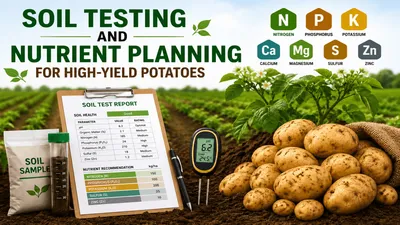
Soil Testing and Nutrient Planning for High-Yield Potatoes
Potato is often called a "heavy feeder" crop because it requires a large amount of nutrients within a relatively short growing period. While farmers frequently invest heavily in fertilizers, many still face issues such as poor tuber size, uneven crop growth, lower yields, and quality problems. In many cases, the issue is not the quantity of fertilizer applied but the lack of understanding of the soil's actual nutrient status. Soil testing is one of the most effective tools available to farmers for improving productivity and profitability. By understanding the nutrient profile of a field before planting, farmers can make informed decisions about fertilizer application and crop management.
Why Soil Testing Matters Every field is different. Even neighboring plots can vary significantly in terms of nutrient availability, organic matter, pH levels, and soil texture. Without a soil test, fertilizer recommendations are often based on assumptions rather than actual requirements. This can lead to: Over-application of certain nutrients Under-application of critical nutrients Higher input costs Reduced nutrient-use efficiency Environmental concerns A soil test helps farmers understand what nutrients are already available and what additional nutrients are required for optimal crop growth.
Key Parameters Measured in Soil Testing 1. Soil pH Soil pH affects nutrient availability and root development. Potatoes generally perform best in slightly acidic soils. When pH levels are too high or too low, plants may struggle to absorb essential nutrients even if those nutrients are present in the soil. 2. Organic Matter Organic matter plays an important role in improving: Soil structure Water retention Microbial activity Nutrient availability Fields with higher organic matter generally show better resilience during periods of moisture stress. 3. Nitrogen (N) Nitrogen supports vegetative growth and canopy development. Adequate nitrogen is necessary for healthy foliage that can efficiently capture sunlight and support tuber formation. However, excessive nitrogen can delay maturity and encourage excessive top growth at the expense of tuber development. 4. Phosphorus (P) Phosphorus is essential during the early stages of crop growth. It promotes: Root development Plant establishment Energy transfer within the plant 5. Potassium (K) Potassium is often considered one of the most important nutrients for potatoes. It: Supports tuber development Improves quality Enhances disease tolerance Contributes to better storage performance 6. Micronutrients Elements such as zinc, boron, sulfur, and magnesium are required in smaller quantities but can have a significant impact on crop performance when deficient. Developing a Nutrient Management Plan Once soil test results are available, farmers can develop a nutrient management strategy tailored to their field conditions.
Basal Fertilizer Application Applied before or during planting, basal fertilizers provide nutrients required during early crop development. Split Nutrient Application Instead of applying all nutrients at once, many growers divide applications across different growth stages. This improves nutrient-use efficiency and reduces nutrient losses. Integrated Nutrient Management Combining chemical fertilizers with organic sources such as: Farmyard manure (FYM) Compost Biofertilizers can improve soil health while maintaining productivity. Benefits of Soil-Based Nutrient Planning Higher Yields Balanced nutrition promotes better tuber initiation, growth, and uniformity. Improved Quality Well-nourished plants produce potatoes with better: Size Shape Dry matter content Marketability Reduced Input Costs Applying only the nutrients that are actually needed helps avoid unnecessary fertilizer expenses. Better Soil Health Long-term nutrient planning helps maintain soil productivity for future seasons. Enhanced Sustainability Efficient fertilizer use reduces nutrient losses and minimizes environmental impact.
Common Mistakes Farmers Should Avoid Applying fertilizers without soil testing Using the same fertilizer program every year regardless of field conditions Ignoring micronutrient deficiencies Over-applying nitrogen in pursuit of higher yields Neglecting organic matter management The Future of Precision Nutrition Advancements in soil mapping, GPS technology, and precision agriculture are making nutrient management more targeted and efficient. Farmers are increasingly adopting data-driven approaches to maximize productivity while minimizing waste. As input costs continue to rise, precision nutrient management is becoming an important component of profitable potato farming.
PB Takeaway Soil testing is not an additional expense—it is an investment in better decision-making. Understanding the nutrient status of a field allows farmers to apply fertilizers more efficiently, improve yields, reduce costs, and build healthier soils for future potato crops.