Schemes for Potato Processing Units in India.
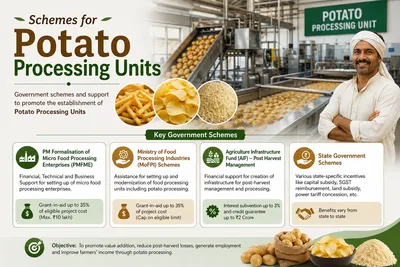
India’s potato processing industry is receiving increasing policy support as the government focuses on food processing expansion, value addition, cold-chain development, and rural industrial growth. Potatoes are one of India’s most important horticultural crops, but a large percentage of production is still consumed in fresh form. Expanding processing capacity is therefore seen as an important opportunity for reducing wastage, improving farmer income stability, and increasing export potential.
Government Support Areas To support this transition, multiple government schemes are available for food processing businesses, cold-chain operators, and agri-infrastructure projects. These schemes may support investments related to: Frozen French fry plants Potato chips manufacturing Flakes and dehydrated products Cold storage infrastructure Grading and sorting units Food logistics systems Ministry of Food Processing Industries (MoFPI) The Ministry of Food Processing Industries (MoFPI) continues to play a major role through various subsidy and infrastructure support programs aimed at strengthening India’s food processing ecosystem. Several states also offer additional incentives for: Land acquisition Electricity support Capital investment Employment generation in food processing sectors Growth of Processing-Focused Farming Processing-focused potato farming is also gaining attention because processors require: Specific potato varieties Consistent dry matter Controlled sugar levels Better quality management As a result, contract farming and processor-linked cultivation models are gradually expanding in states such as Gujarat, Uttar Pradesh, Punjab, and Madhya Pradesh. Cold-Chain Development Cold-chain development remains another major focus area. Government-backed infrastructure initiatives are encouraging investments in: Temperature-controlled storage Reefer transportation Packhouses Integrated supply chains Future Growth Potential Industry experts believe India’s potato processing sector still has significant long-term growth potential because only a relatively small share of total potato production currently enters organised processing compared to Europe or North America.
The expansion of: Quick-service restaurants Organised retail Frozen food consumption Snack manufacturing is expected to continue driving demand for processed potato products in the coming years. Conclusion For entrepreneurs and investors, understanding available subsidy schemes and infrastructure incentives may become increasingly important while planning future potato processing projects.