ICAR Notifies Four New Potato Varieties for Nationwide Cultivation and Processing
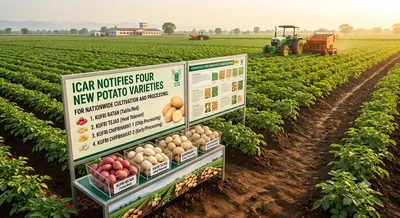
The Ministry of Agriculture and Farmers Welfare has officially notified four new potato varieties developed by ICAR–Central Potato Research Institute (ICAR-CPRI), Shimla, opening them for seed production and multiplication across India.
The new varieties include Kufri Ratan, Kufri Tejas, Kufri Chipbharat-1 and Kufri Chipbharat-2. While two are aimed mainly at table-potato production, the other two have been developed specifically for chip processing.
The development is important for farmers because the new varieties combine characteristics such as higher yield, disease/heat tolerance, storability and processing suitability. For the processing industry, the two Chipbharat varieties could help improve the availability of potatoes with suitable quality characteristics.
📊 Four New Potato Varieties at a Glance
| Variety | Main Use | Maturity | Yield Potential | Key Feature |
|---|---|---|---|---|
| Kufri Ratan | Table Potato | 90 days | 37–39 t/ha | Red skin, good storability |
| Kufri Tejas | Table Potato | 90 days | 37–40 t/ha | Heat tolerant, good ambient storage |
| Kufri Chipbharat-1 | Chip Processing | 100 days | 35–38 t/ha | 21% dry matter, low reducing sugars |
| Kufri Chipbharat-2 | Chip Processing | 90 days | 35–37 t/ha | Early maturity, good storability |
Yield figures are the potential ranges reported by ICAR-CPRI, not guaranteed farm yields.
🌱 Why Are the New Varieties Important?
For Farmers
Kufri Ratan is a medium-maturing red-skinned table potato with wide adaptability across the North Indian plains and plateau regions.
Kufri Tejas stands out for its heat tolerance and is reported as suitable for plains including Haryana, Punjab, Uttar Pradesh, Madhya Pradesh, Gujarat and Maharashtra.
This could be particularly relevant as farmers increasingly need varieties that can perform under changing temperature conditions.
🍟 A Bigger Opportunity for Potato Processing
The two Chipbharat varieties are specifically designed for chip processing.
Kufri Chipbharat-1 and Kufri Chipbharat-2 have high dry matter and low reducing sugars, characteristics that are important for producing acceptable-quality potato chips.
For processors, consistent raw material quality is critical. For farmers, this creates a potential opportunity to move from producing potatoes only for the fresh market toward variety-specific production for processing buyers.
📈 Variety Focus
Table Potato
Kufri Ratan → 🥔 Fresh Market
Kufri Tejas → 🌡️ Heat Tolerance + Fresh Market
Processing Potato
Kufri Chipbharat-1 → 🍟 Chips
Kufri Chipbharat-2 → 🍟 Chips
🇮🇳 What This Could Mean for the Potato Sector
👨🌾 Farmers
The new varieties give farmers more options to select varieties according to region, climate and target market.
🏭 Processors
The Chipbharat varieties could support a more consistent supply of potatoes suitable for chip manufacturing.
❄️ Cold Storage Owners
The reported storability of several of the varieties could be useful for managing stocks beyond harvest, although actual storage performance will depend on storage conditions and management.
🚜 Seed Sector
Official notification for seed production and multiplication creates scope for wider availability of these varieties as planting material develops.
🟢 PB Takeaway
The notification of four new ICAR-CPRI potato varieties is more than just a new seed announcement. It reflects a growing focus on producing potatoes according to specific farmer, climate and processing requirements.
For farmers, the key lesson is to choose the variety based on the intended buyer and market before planting. For processors, the availability of dedicated chip-processing varieties could strengthen the link between farm production and industrial demand.