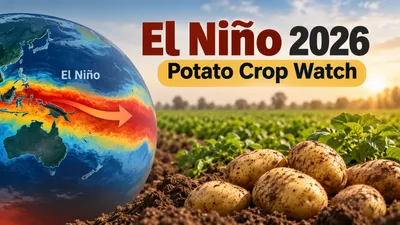
El Niño 2026: Potato Crop Watch
Very Strong El Niño Developing: What Could It Mean for India’s 2026–27 Potato Crop?
A very strong El Niño is developing ahead of India’s main potato season. While it is too early to predict an impact on production, temperature and moisture conditions during October–December will need particularly close monitoring.
The World Meteorological Organization (WMO), in its latest update dated 3 September 2026, has confirmed that El Niño is firmly established and is expected to strengthen into a very strong event in the coming months.
WMO forecasts indicate a nearly 100% likelihood that El Niño will persist through February 2027, with the event expected to peak towards the end of 2026. This period overlaps with planting, tuber initiation and early bulking of India's main potato crop.
However, WMO also cautions that the strength of an El Niño does not translate directly into the magnitude of its impact in any particular region. Therefore, a strong El Niño should not by itself be interpreted as a forecast of lower potato production.
Why Night Temperature Matters for Potato
For potato, one of the most important variables to watch will be minimum/night temperature during tuber formation.
Research published in ICAR's Potato Journal shows that potatoes can produce satisfactory yields even with daytime temperatures of 30–35°C if nights remain below about 18°C. However, tuberisation can be limited when night temperatures exceed about 22°C.
High temperatures during sensitive stages can delay tuber initiation, affect bulking and ultimately influence tuber size and yield. Heat stress can also increase physiological disorders and secondary growth.
This means that for the coming season, October–November night temperatures across India's major potato belts could be more relevant to the crop than the El Niño label itself.
State-wise Potato Watch
Uttar Pradesh:
As India's largest potato belt, UP will be particularly important for the national crop outlook. Watch whether minimum temperatures decline normally through late October and November in Agra, Firozabad, Farrukhabad, Kannauj and adjoining belts. A prolonged warm spell during early crop development could delay favourable tuberisation conditions.
Gujarat:
Gujarat deserves particularly close monitoring because potatoes are already grown under relatively warmer conditions. ICAR research has specifically evaluated heat-tolerant potato material under Gujarat's warmer potato-growing environment. Banaskantha, Sabarkantha, Aravalli and the Deesa belt should be watched for both night-temperature trends and irrigation requirements.
Punjab:
Irrigation availability provides some protection against rainfall or soil-moisture stress, making temperature an important variable to watch. For both early/table potato and the important seed crop, the timing of cooler nights during October–November will be significant.
Bihar & West Bengal:
Here too, the arrival and persistence of favourable winter temperatures will be important. Potato Bazaar will watch whether post-monsoon temperatures decline normally and whether any unusual moisture conditions emerge during crop establishment and subsequent tuber development.
Five Signals the Potato Industry Should Track
Rather than following El Niño alone, the potato industry should watch:
🌡️ Minimum temperature: Are night temperatures remaining above their normal levels?
🌙 Warm nights: Are important potato belts experiencing repeated nights around or above the 20–22°C range during tuber initiation?
🥔 Planting & tuberisation: Is warm weather causing farmers to delay planting or slowing the onset of favourable tuber-forming conditions?
💧 Soil moisture & irrigation: Any extended dry conditions could increase irrigation dependence. Potato's relatively shallow root system makes moisture availability important, particularly during tuber development.
📍 Regional divergence: UP, Gujarat, Punjab, Bihar and West Bengal may respond differently. A national El Niño classification should therefore not be treated as a uniform potato-weather forecast.
There Could Also Be Some Offsetting Factors
El Niño is not the only climate driver affecting India. WMO's latest September–November outlook also expects a positive Indian Ocean Dipole (IOD) to develop.
Its interaction with El Niño can alter regional rainfall and temperature patterns. Local weather conditions therefore need to be monitored rather than assuming that historical El Niño behaviour will simply repeat itself in 2026.
Irrigation can also significantly reduce moisture-related stress in major irrigated potato belts, although it cannot fully compensate for persistently excessive temperatures during tuber formation.
PB Takeaway
The very strong El Niño has increased weather-related uncertainty for India's 2026–27 potato season—but there is currently no scientific basis to conclude that India's potato crop will necessarily be lower.
The key period will be October to December.
If major potato belts experience persistently warmer-than-normal nights during planting and tuber initiation, risks to tuber formation and bulking would increase. Conversely, if winter temperatures arrive normally and irrigation remains adequate, much of the potential risk could be moderated.
What We Need To Watch
October: Planting progress + arrival of cooler night temperatures
November: Minimum-temperature trend + tuber initiation conditions
December: Temperature + tuber bulking + emerging crop condition
For the potato industry, the question is therefore not simply “How strong is El Niño?” but “How warm will the nights be in India's potato belts during the critical crop stages?”