Processing Potato Farming Enters New Phase as Gujarat-Based Farm Peace Opens IPO
🥔 Processing Potato Farming Enters New Phase as Gujarat-Based Farm Peace Opens IPO
Summary
India's organised processing-potato ecosystem has reached another milestone with Gujarat-based Farm Peace Limited opening its ₹32-crore SME IPO on 1 September 2026. The company specialises in contract farming of potatoes for French fries, chips and other processed potato products, linking growers with certified seed, technical support and assured buy-back arrangements.
Key Highlights
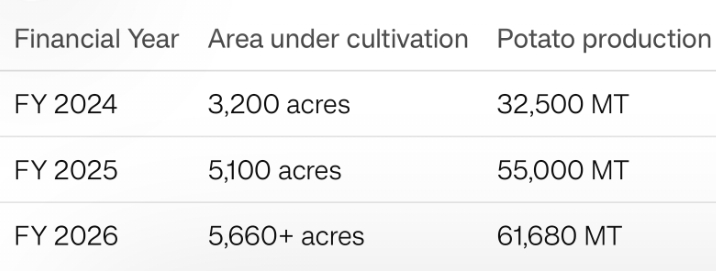
₹32 crore IPO | 61,680 MT potato production | 5,660+ acres | Processing varieties | 100% buy-back model | North Gujarat
Processing Potatoes at the Core
Farm Peace, incorporated in 2021 and headquartered in Ahmedabad, focuses specifically on potatoes required by processing companies.
Its portfolio includes processing varieties such as Santana, Frysona, Innovator, Lady Rosetta and Chipsona, used for French fries, potato chips and other value-added products.
This is different from the conventional model where farmers produce potatoes and subsequently look for buyers in the open market. Under Farm Peace's contract-farming model, production is linked to the requirements of processors from the beginning of the crop cycle.
The operations are concentrated in the major North Gujarat potato belt covering Sabarkantha, Aravalli, Mehsana and Banaskantha.
How the Contract Farming Model Works
Farm Peace says it operates a 100% buy-back model.
Participating farmers receive certified seed varieties along with agronomic and technical assistance covering areas such as land preparation, sowing, irrigation, pest management, harvesting and post-harvest handling. The company, in turn, procures the contracted production at pre-agreed prices subject to agreed quality parameters.
The model addresses two different requirements simultaneously: farmers receive greater visibility on their intended buyer and commercial terms, while processors get access to potatoes grown according to specified varieties and quality requirements.
Technology & Traceability Also Part of the Model
The company also operates a proprietary Farm Peace mobile application, launched in September 2023, which it says supports transparency, traceability and management across the crop cycle.
This is increasingly important in processing potatoes because processors require consistency in parameters such as variety, tuber size, dry matter, reducing sugars, defects and processing performance.
IPO Details
The BSE SME issue comprises 54.24 lakh fresh equity shares at ₹59 per share, aggregating to approximately ₹32 crore. It opened on 1 September and closes on 3 September, with listing scheduled for 8 September.
According to the IPO disclosures, about ₹23 crore of the proceeds is intended for incremental working-capital requirements, with the balance including general corporate purposes.
Why This Matters for India's Potato Industry
The significance of the development extends beyond one company's IPO.
India's potato value chain is increasingly developing into distinct segments:
Table potato → Open-market/mandi driven
Processing potato → Variety-specific + contract farming + quality specifications + assured processor linkage
As domestic demand for French fries, chips and other processed potato products expands, processors require increasingly predictable supplies of potatoes with specific characteristics.
That creates opportunities not only for processors, but across the ecosystem—processing-grade seed, contract farming, agronomy services, grading, cold storage, logistics, traceability and farmer aggregation.
The Farm Peace IPO is therefore an interesting indicator of how organised processing-potato farming in India is beginning to develop into a scalable and investible agricultural business model.
PB Market Perspective
For potato growers, the important takeaway is not the IPO itself but the changing nature of potato production.
As processing expands, the decision on which variety to grow and for whom increasingly needs to be made before planting. Farmers linked to processors may gain greater market visibility, but they must also meet stricter quality and production specifications.