Market & Trade
Why Potato Prices Crash During Peak Harvest — Lessons from Mainpuri and Beyond
23 January 2026
Why Potato Prices Crash During Peak Harvest — Lessons from Mainpuri and Beyond
Understanding Market Cycles, Storage Gaps, and Structural Price Risks
Introduction
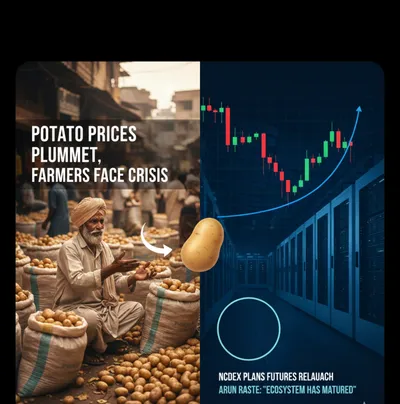
Potato price volatility during harvest season is a recurring challenge in India’s agri-markets. The recent price crash reported in Mainpuri, Uttar Pradesh (January 2026) — where wholesale rates fell below production cost — has once again brought attention to how quickly market conditions can turn unfavourable for farmers despite a healthy crop.
While the trigger in Mainpuri was a sudden surge in arrivals, the underlying causes go deeper. This article analyses why such price crashes occur, what they reveal about India’s potato value chain, and how different stakeholders can respond more strategically.
1. Harvest Pressure and Synchronized Supply
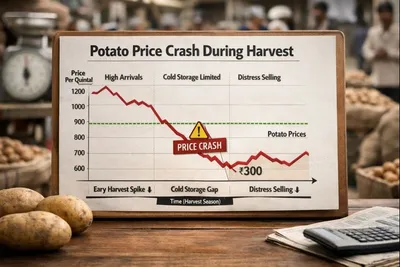
During peak harvest months, particularly January and February, large volumes of potatoes arrive in mandis within a short time window. In Mainpuri, many farmers opted for early harvesting to prepare land for wheat sowing, resulting in a sharp spike in mandi arrivals.
When multiple villages and districts harvest simultaneously:
• Buyer capacity becomes limited
• Auctions turn price-competitive
• Rates adjust downward rapidly
Even stable demand struggles to absorb such concentrated supply, leading to short-term price collapse.
2. Not an Isolated Incident — A Broader Market Pattern
The situation witnessed in Mainpuri is not an isolated incident. Similar price pressure and market behaviour are increasingly being reported from other potato mandis across Uttar Pradesh, Bihar, West Bengal, and parts of central India.
This indicates a broader structural issue, rather than a localised disruption. Synchronized harvesting, dependence on spot markets, limited storage flexibility, and uneven demand absorption are creating repeating cycles of distress pricing across regions.
3. Dependence on Spot Mandis and Limited Price Control
Most table-potato farmers continue to rely on spot mandi auctions, where prices are discovered daily and driven by immediate supply–demand dynamics. In such systems:
• Farmers have minimal bargaining power
• Production cost has little influence on price
• Distress selling increases during peak arrivals
In contrast, processors and organised buyers operating through contracts or forward planning face lower volatility due to assured offtake and predefined quality norms.
4. Cold Storage Access as a Price Stabiliser
Cold storage availability — or the lack of it — plays a decisive role during harvest season.
Farmers without:
•Nearby storage facilities
• Affordable storage charges
• Working capital to hold produce
are compelled to sell immediately, regardless of price levels.
Regions with stronger cold storage penetration generally experience:
•Staggered market arrivals
•Reduced distress selling
• Better price realisation over time
This makes storage not just an infrastructure asset, but a market-risk management tool.
5. Quality Segmentation and Market Differentiation
Market feedback suggests that better-graded potatoes continue to command marginally higher prices, even during weak markets. However, in most mandis, produce enters as undifferentiated bulk, pulling overall prices down.
Limited grading, sorting, and variety segregation at the farm and trader level restrict the development of quality-linked pricing.
PB Insight Box
Price crashes during harvest are less about overproduction and more about timing, storage, and coordination.
Without staggered supply, demand linkage, and holding capacity, even a good potato crop can turn economically unviable for farmers.
6. Strategic Takeaways for Stakeholders
For Farmers
• Plan staggered harvesting where feasible
• Use cold storage as a timing tool, not just a warehouse
• Explore linkages with FPOs, aggregators, and processors
For Traders & Commission Agents
• Improve lot-wise grading and transparency
• Track multi-mandi price trends before bulk procurement
• For Cold Storage Operators
• Offer flexible short-term storage models
• Support farmer education on price cycles and release timing
Conclusion
The Mainpuri price crash serves as a reminder that market structure matters as much as production. Without coordinated harvest planning, adequate storage access, and stronger demand integration, price volatility will continue to challenge India’s potato ecosystem.
A more resilient value chain requires planning, infrastructure, and information — not just higher yields.
Quick Knowledge Facts
Reference region: Mainpuri, Uttar Pradesh
Core issue: Synchronized harvest + limited storage leverage
Key risk: Distress selling at peak arrivals
Long-term solution: Storage, contracts, and quality-linked markets
Understanding Market Cycles, Storage Gaps, and Structural Price Risks
Introduction
Potato price volatility during harvest season is a recurring challenge in India’s agri-markets. The recent price crash reported in Mainpuri, Uttar Pradesh (January 2026) — where wholesale rates fell below production cost — has once again brought attention to how quickly market conditions can turn unfavourable for farmers despite a healthy crop.
While the trigger in Mainpuri was a sudden surge in arrivals, the underlying causes go deeper. This article analyses why such price crashes occur, what they reveal about India’s potato value chain, and how different stakeholders can respond more strategically.
1. Harvest Pressure and Synchronized Supply
During peak harvest months, particularly January and February, large volumes of potatoes arrive in mandis within a short time window. In Mainpuri, many farmers opted for early harvesting to prepare land for wheat sowing, resulting in a sharp spike in mandi arrivals.
When multiple villages and districts harvest simultaneously:
• Buyer capacity becomes limited
• Auctions turn price-competitive
• Rates adjust downward rapidly
Even stable demand struggles to absorb such concentrated supply, leading to short-term price collapse.
2. Not an Isolated Incident — A Broader Market Pattern
The situation witnessed in Mainpuri is not an isolated incident. Similar price pressure and market behaviour are increasingly being reported from other potato mandis across Uttar Pradesh, Bihar, West Bengal, and parts of central India.
This indicates a broader structural issue, rather than a localised disruption. Synchronized harvesting, dependence on spot markets, limited storage flexibility, and uneven demand absorption are creating repeating cycles of distress pricing across regions.
3. Dependence on Spot Mandis and Limited Price Control
Most table-potato farmers continue to rely on spot mandi auctions, where prices are discovered daily and driven by immediate supply–demand dynamics. In such systems:
• Farmers have minimal bargaining power
• Production cost has little influence on price
• Distress selling increases during peak arrivals
In contrast, processors and organised buyers operating through contracts or forward planning face lower volatility due to assured offtake and predefined quality norms.
4. Cold Storage Access as a Price Stabiliser
Cold storage availability — or the lack of it — plays a decisive role during harvest season.
Farmers without:
•Nearby storage facilities
• Affordable storage charges
• Working capital to hold produce
are compelled to sell immediately, regardless of price levels.
Regions with stronger cold storage penetration generally experience:
•Staggered market arrivals
•Reduced distress selling
• Better price realisation over time
This makes storage not just an infrastructure asset, but a market-risk management tool.
5. Quality Segmentation and Market Differentiation
Market feedback suggests that better-graded potatoes continue to command marginally higher prices, even during weak markets. However, in most mandis, produce enters as undifferentiated bulk, pulling overall prices down.
Limited grading, sorting, and variety segregation at the farm and trader level restrict the development of quality-linked pricing.
PB Insight Box
Price crashes during harvest are less about overproduction and more about timing, storage, and coordination.
Without staggered supply, demand linkage, and holding capacity, even a good potato crop can turn economically unviable for farmers.
6. Strategic Takeaways for Stakeholders
For Farmers
• Plan staggered harvesting where feasible
• Use cold storage as a timing tool, not just a warehouse
• Explore linkages with FPOs, aggregators, and processors
For Traders & Commission Agents
• Improve lot-wise grading and transparency
• Track multi-mandi price trends before bulk procurement
• For Cold Storage Operators
• Offer flexible short-term storage models
• Support farmer education on price cycles and release timing
Conclusion
The Mainpuri price crash serves as a reminder that market structure matters as much as production. Without coordinated harvest planning, adequate storage access, and stronger demand integration, price volatility will continue to challenge India’s potato ecosystem.
A more resilient value chain requires planning, infrastructure, and information — not just higher yields.
Quick Knowledge Facts
Reference region: Mainpuri, Uttar Pradesh
Core issue: Synchronized harvest + limited storage leverage
Key risk: Distress selling at peak arrivals
Long-term solution: Storage, contracts, and quality-linked markets
Tags
#PotatoBazaarKnowledge#HarvestManagement#PotatoPrices