Market
8 April 2026
26 views
Source:Team Potato Bazaar
India Potato Market Update: Bumper Harvest Triggers Price Crash Across Key States
India Potato Market Update: Bumper Harvest Triggers Price Crash Across Key States
📉 Bumper Production Leads to Price Pressure
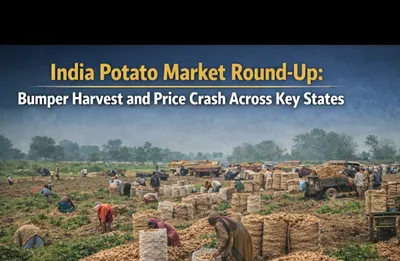
India’s potato market in March and early April 2026 is witnessing a significant supply glut, driven by a bumper harvest estimated at ~60 million tonnes.
While production strength reflects a healthy crop cycle, it has created severe downward pressure on prices, especially in eastern India.
Farmers across key producing belts are facing low realizations, storage constraints, and distress sales, even as consumer prices remain relatively stable.
🌾West Bengal: Crisis Amid Record Output
West Bengal is currently at the center of the crisis:
Record Production: Estimated at 130–150 lakh tonnes, significantly higher than last year.
Sharp Price Fall: Wholesale prices have dropped to ₹4–₹5/kg, below the ~₹7.5/kg production cost
Storage Gap: North Bengal cold storages can handle only ~1.6 million tonnes against a ~4.1 million tonne output, leaving large quantities exposed to spoilage.
To ease pressure, the state government has lifted restrictions on inter-state movement, allowing farmers to sell outside West Bengal.
📊 Uttar Pradesh: Distress Sales in Mandis
In Uttar Pradesh mandis, price realization varies sharply by quality:
Farrukhabad Mandi Prices:
Good quality: ₹700–₹750/quintal
Low/damaged stock: as low as ₹200/quintal
Market Trend:
Farmers are bringing “dumped stock” (field-stored potatoes) to mandis to clear land for the next crop, increasing supply pressure and further weakening prices.
🌾 Gujarat (Banaskantha–Sabarkantha Belt): High Activity, Better Price Discovery
Key Belts: Banaskantha (Deesa) and Sabarkantha remained highly active during March
Arrival Pattern: Strong arrivals in early March, followed by shift towards cold storage stocking and controlled releases
Price Range:
Early March: ₹800–₹1,000/quintal
Late March: ₹600–₹800/quintal depending on quality
Market Dynamics: Continuous inter-state trade movement (UP, MP, Maharashtra) helped absorb supply
Farmers:
Combination of fresh sale + storage + trader-led movement, avoiding distress unloading
🌾 Punjab: Stable Market Supported by Storage & Phased Selling
Arrival Trend (March): Moderate arrivals as a large portion of crop moved directly to cold storage
Price Range:
Early March: ₹900–₹1,100/quintal
Late March: softened to ₹700–₹900/quintal
Market Behaviour: No panic selling; farmers opted for storage + staggered sale strategy
Storage Impact: High cold storage utilisation (70–80%+) helped avoid distress dumping
Demand Side: Steady offtake from traders and processing units supported price stability
🛒 Retail Prices Remain Stable
Despite the wholesale crash, retail prices across states remain relatively steady, indicating that the benefit of lower mandi prices has not fully passed on to consumers.
🚀 Industry Developments & Future Outlook
1. New Potato Varieties
The Indian Council of Agricultural Research has introduced four improved varieties:
Kufri Ratan
Kufri Tejas
Kufri Chipbharat-1
Kufri Chipbharat-2
👉 Focus: higher yield, heat tolerance, and processing suitability
2. Processing Sector Growth
India is emerging as a strong player in processed potato exports, particularly frozen fries, with shipments reportedly seeing ~350% YoY growth to the US market.
3. Futures Market Revival
The National Commodity & Derivatives Exchange Limited is considering relaunching potato futures in 2026, which could help farmers and traders hedge against price volatility.
⚖️ PB Insight: Short-Term Pain, Long-Term Opportunity
The current glut highlights structural gaps in:
• Storage infrastructure
•Market linkages
• Processing capacity
While farmers face immediate distress due to low prices, the situation presents an opportunity to:
• Expand cold storage and supply chain infrastructure
• Strengthen inter-state and export linkages
• Accelerate processing industry growth
India’s potato market in March and early April 2026 is witnessing a significant supply glut, driven by a bumper harvest estimated at ~60 million tonnes.
While production strength reflects a healthy crop cycle, it has created severe downward pressure on prices, especially in eastern India.
Farmers across key producing belts are facing low realizations, storage constraints, and distress sales, even as consumer prices remain relatively stable.
🌾West Bengal: Crisis Amid Record Output
West Bengal is currently at the center of the crisis:
Record Production: Estimated at 130–150 lakh tonnes, significantly higher than last year.
Sharp Price Fall: Wholesale prices have dropped to ₹4–₹5/kg, below the ~₹7.5/kg production cost
Storage Gap: North Bengal cold storages can handle only ~1.6 million tonnes against a ~4.1 million tonne output, leaving large quantities exposed to spoilage.
To ease pressure, the state government has lifted restrictions on inter-state movement, allowing farmers to sell outside West Bengal.
📊 Uttar Pradesh: Distress Sales in Mandis
In Uttar Pradesh mandis, price realization varies sharply by quality:
Farrukhabad Mandi Prices:
Good quality: ₹700–₹750/quintal
Low/damaged stock: as low as ₹200/quintal
Market Trend:
Farmers are bringing “dumped stock” (field-stored potatoes) to mandis to clear land for the next crop, increasing supply pressure and further weakening prices.
🌾 Gujarat (Banaskantha–Sabarkantha Belt): High Activity, Better Price Discovery
Key Belts: Banaskantha (Deesa) and Sabarkantha remained highly active during March
Arrival Pattern: Strong arrivals in early March, followed by shift towards cold storage stocking and controlled releases
Price Range:
Early March: ₹800–₹1,000/quintal
Late March: ₹600–₹800/quintal depending on quality
Market Dynamics: Continuous inter-state trade movement (UP, MP, Maharashtra) helped absorb supply
Farmers:
Combination of fresh sale + storage + trader-led movement, avoiding distress unloading
🌾 Punjab: Stable Market Supported by Storage & Phased Selling
Arrival Trend (March): Moderate arrivals as a large portion of crop moved directly to cold storage
Price Range:
Early March: ₹900–₹1,100/quintal
Late March: softened to ₹700–₹900/quintal
Market Behaviour: No panic selling; farmers opted for storage + staggered sale strategy
Storage Impact: High cold storage utilisation (70–80%+) helped avoid distress dumping
Demand Side: Steady offtake from traders and processing units supported price stability
🛒 Retail Prices Remain Stable
Despite the wholesale crash, retail prices across states remain relatively steady, indicating that the benefit of lower mandi prices has not fully passed on to consumers.
🚀 Industry Developments & Future Outlook
1. New Potato Varieties
The Indian Council of Agricultural Research has introduced four improved varieties:
Kufri Ratan
Kufri Tejas
Kufri Chipbharat-1
Kufri Chipbharat-2
👉 Focus: higher yield, heat tolerance, and processing suitability
2. Processing Sector Growth
India is emerging as a strong player in processed potato exports, particularly frozen fries, with shipments reportedly seeing ~350% YoY growth to the US market.
3. Futures Market Revival
The National Commodity & Derivatives Exchange Limited is considering relaunching potato futures in 2026, which could help farmers and traders hedge against price volatility.
⚖️ PB Insight: Short-Term Pain, Long-Term Opportunity
The current glut highlights structural gaps in:
• Storage infrastructure
•Market linkages
• Processing capacity
While farmers face immediate distress due to low prices, the situation presents an opportunity to:
• Expand cold storage and supply chain infrastructure
• Strengthen inter-state and export linkages
• Accelerate processing industry growth
#PotatoMarketIndia#MarketRoundUp#PotatoPrices#FarmerDistress#PotatoSupplyGlut#PotatoRatesIndia