Market
31 March 2026
41 views
Source:Team Potato Bazaar
Cold Chain: How the 2026 Iran Conflict is Destabilizing India’s Ammonia Supply and Potato Security
Cold Chain: How the 2026 Iran Conflict is Destabilizing India’s Ammonia Supply and Potato Security
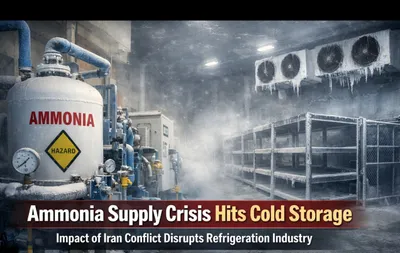
Crisis in the Cold Chain: Geopolitics, Ammonia, and India’s Potato Security
The following presentation paper outlines the critical intersection of the 2026 Middle East conflict ("Iran-warm"), the resultant ammonia shortage, and the existential threat to India’s potato storage infrastructure.
I. Global Context: The 2026 Middle East Energy Shock
The conflict involving Iran and Israel, culminating in the closure of the Strait of Hormuz on March 4, 2026, has triggered the most severe ammonia supply disruption in India’s history.
• Import Reliance: India imports nearly 20-25% of its total fertilizer and industrial ammonia inputs directly through the Strait.
• The Qatar Factor: India relies on Qatar for 44% of its LNG (Liquefied Natural Gas) imports. Following QatarEnergy’s declaration of force majeure in mid-March, domestic ammonia synthesis plants—which use LNG as a primary feedstock—have seen a 10-15% drop in annual production capacity.
• Logistics & Freight: With the Persian Gulf route compromised, freight costs for alternative shipments have surged, pushing global ammonia prices toward $684 - $750 per tonne as of late March 2026.
II. Domestic Impact: The Ammonia "Triple Squeeze"
India’s industrial sector is facing a prioritized distribution model that favors food security (fertilizers) over industrial cooling.
• Sectoral Diversion: The Government of India has currently diverted approximately 70% of available natural gas and ammonia stocks to urea production to safeguard the upcoming Kharif season.
• The Cold Chain Gap: This leaves the cold storage sector—which utilizes ammonia (NH_3) for 80% of its total capacity—facing a severe deficit of refrigerant-grade gas.
• Price Escalation: In domestic markets (e.g., Uttar Pradesh and West Bengal), the cost of refilling or "charging" ammonia systems has risen by an estimated 50-70% compared to the 2025 season.
III. The Potato Perspective: Vulnerability of the 2026 Harvest
The potato is the most "ammonia-dependent" crop in India. Unlike grains, potatoes are living organisms that require precise atmospheric control to prevent rot.
• Critical Mass: As of March 20, 2026, 150 lakh metric tonnes of potatoes are stored across 2,357 cold storages in Uttar Pradesh alone. Nationwide, nearly 90% of cold storage capacity is dedicated to this single crop.
• Biological Risks: To prevent sprouting and "sweetening" (starch-to-sugar conversion), potatoes must be held at a steady 2°C to 4°C. Ammonia shortages lead to "load-shedding" of cooling cycles, which can cause internal bruising and physiological breakdown.
• Averted Crisis: In late March, timely intervention by the Ministry of Horticulture and the Central Government was required to restore gas supply to UP’s storage units after a two-day disruption threatened to spoil the entire state’s inventory.
IV. Economic Consequences: From Farm to Fork
The "Iran-warm" conflict is directly translating into food inflation for the Indian consumer.
• Operational Costs: Storage owners are facing increased electricity bills (due to higher fuel costs) and ammonia maintenance fees, leading to a projected hike in storage rentals of ₹15 - ₹25 per quintal.
• Market Volatility: Market analysts project that if supply chain disruptions persist through June, retail potato prices in urban centers could surge by 25-30% by the festive season (Q3 2026).
• Wastage Forecast: Post-harvest losses, usually around 5-7%, are expected to climb toward 12-15% this year due to inconsistent cooling and aging infrastructure.
V. Long-Term Mitigation: The Green Ammonia Pivot
To decouple from Middle Eastern volatility, India is accelerating the National Green Hydrogen Mission.
• Price Breakthrough: On March 30, 2026, a landmark Green Ammonia Purchase Agreement (GAPA) was signed by NTPC and SECI, targeting a supply of 70,000 MTPA.
• Capacity Targets: The government is aggregating demand for 724,000 tonnes per year of green ammonia across 13 fertilizer units to insulate the agricultural sector from future fossil-fuel shocks.
• Standards: As of March 7, 2026, India officially notified its Green Ammonia Standards, capping emissions at 0.38 kg CO_2 per kg of NH_3 to ensure future storage units are both environmentally and geopolitically resilient.
The following presentation paper outlines the critical intersection of the 2026 Middle East conflict ("Iran-warm"), the resultant ammonia shortage, and the existential threat to India’s potato storage infrastructure.
I. Global Context: The 2026 Middle East Energy Shock
The conflict involving Iran and Israel, culminating in the closure of the Strait of Hormuz on March 4, 2026, has triggered the most severe ammonia supply disruption in India’s history.
• Import Reliance: India imports nearly 20-25% of its total fertilizer and industrial ammonia inputs directly through the Strait.
• The Qatar Factor: India relies on Qatar for 44% of its LNG (Liquefied Natural Gas) imports. Following QatarEnergy’s declaration of force majeure in mid-March, domestic ammonia synthesis plants—which use LNG as a primary feedstock—have seen a 10-15% drop in annual production capacity.
• Logistics & Freight: With the Persian Gulf route compromised, freight costs for alternative shipments have surged, pushing global ammonia prices toward $684 - $750 per tonne as of late March 2026.
II. Domestic Impact: The Ammonia "Triple Squeeze"
India’s industrial sector is facing a prioritized distribution model that favors food security (fertilizers) over industrial cooling.
• Sectoral Diversion: The Government of India has currently diverted approximately 70% of available natural gas and ammonia stocks to urea production to safeguard the upcoming Kharif season.
• The Cold Chain Gap: This leaves the cold storage sector—which utilizes ammonia (NH_3) for 80% of its total capacity—facing a severe deficit of refrigerant-grade gas.
• Price Escalation: In domestic markets (e.g., Uttar Pradesh and West Bengal), the cost of refilling or "charging" ammonia systems has risen by an estimated 50-70% compared to the 2025 season.
III. The Potato Perspective: Vulnerability of the 2026 Harvest
The potato is the most "ammonia-dependent" crop in India. Unlike grains, potatoes are living organisms that require precise atmospheric control to prevent rot.
• Critical Mass: As of March 20, 2026, 150 lakh metric tonnes of potatoes are stored across 2,357 cold storages in Uttar Pradesh alone. Nationwide, nearly 90% of cold storage capacity is dedicated to this single crop.
• Biological Risks: To prevent sprouting and "sweetening" (starch-to-sugar conversion), potatoes must be held at a steady 2°C to 4°C. Ammonia shortages lead to "load-shedding" of cooling cycles, which can cause internal bruising and physiological breakdown.
• Averted Crisis: In late March, timely intervention by the Ministry of Horticulture and the Central Government was required to restore gas supply to UP’s storage units after a two-day disruption threatened to spoil the entire state’s inventory.
IV. Economic Consequences: From Farm to Fork
The "Iran-warm" conflict is directly translating into food inflation for the Indian consumer.
• Operational Costs: Storage owners are facing increased electricity bills (due to higher fuel costs) and ammonia maintenance fees, leading to a projected hike in storage rentals of ₹15 - ₹25 per quintal.
• Market Volatility: Market analysts project that if supply chain disruptions persist through June, retail potato prices in urban centers could surge by 25-30% by the festive season (Q3 2026).
• Wastage Forecast: Post-harvest losses, usually around 5-7%, are expected to climb toward 12-15% this year due to inconsistent cooling and aging infrastructure.
V. Long-Term Mitigation: The Green Ammonia Pivot
To decouple from Middle Eastern volatility, India is accelerating the National Green Hydrogen Mission.
• Price Breakthrough: On March 30, 2026, a landmark Green Ammonia Purchase Agreement (GAPA) was signed by NTPC and SECI, targeting a supply of 70,000 MTPA.
• Capacity Targets: The government is aggregating demand for 724,000 tonnes per year of green ammonia across 13 fertilizer units to insulate the agricultural sector from future fossil-fuel shocks.
• Standards: As of March 7, 2026, India officially notified its Green Ammonia Standards, capping emissions at 0.38 kg CO_2 per kg of NH_3 to ensure future storage units are both environmentally and geopolitically resilient.
#Amonia#potato cold storage