The Potato Processing Outlook: A $50 Billion Industrial Evolution
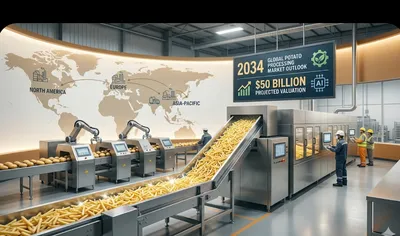
The global potato processing industry is moving far beyond traditional chips and French fries. Driven by changing food habits, urbanisation, convenience demand, and new industrial applications, potatoes are becoming an increasingly important raw material for the global food economy.
The global potato processing market, valued at approximately $30.5 billion in 2024, is projected to reach around $50.2 billion by 2034, reflecting strong long-term growth.
Future Outlook: Moving Towards a Smarter Supply Chain
The next decade is expected to bring major technological changes to potato processing.
Processing plants are increasingly adopting technologies such as:
- AI-based quality monitoring
- Optical sorting systems
- Automated processing lines
- Digital supply-chain tracking
- Data-based production planning
Advanced sorting technologies can help identify defects and improve raw material utilisation, reducing waste during processing.
Sustainability is also becoming an important focus. Future processing plants are expected to increase the use of:
- Water recycling systems
- Energy-efficient equipment
- Waste-to-energy solutions
- By-product utilisation
Potato peels and other processing waste may increasingly be used for bio-energy, animal feed, starch recovery, and other value-added applications.
Product Breakdown: More Than Just French Fries
Frozen Potato Products
Frozen potato products, including French fries, wedges, and speciality products, remain one of the largest segments of the industry.
Growth is being supported by:
- Expansion of Quick Service Restaurants (QSRs)
- Growth in food delivery
- Rising consumption of convenience foods
- Expansion of organised retail
French fries are expected to remain a major driver of processing potato demand through the next decade.
Chips and Snack Products
The chips and snack segment continues to evolve as consumers look for new flavours and healthier alternatives.
Future product trends may include:
- Air-fried products
- Reduced-sodium chips
- Vacuum-fried snacks
- Clean-label products
- New flavours and premium snack categories
This creates opportunities for processors to develop higher-value potato products.
Dehydrated Potato Products
Dehydrated potatoes, including flakes, granules, and powder, are gaining importance because of their:
- Long shelf life
- Lower transportation requirements
- Convenience
- Use in ready-to-eat and food-service products
This segment is expected to benefit from the continued growth of convenience foods and industrial food manufacturing.
Potato Starch and Industrial Applications
Potato processing is also expanding beyond food.
Potato starch and its derivatives are used in areas such as:
- Food manufacturing
- Pharmaceuticals
- Textiles
- Paper and packaging
- Biodegradable materials
The growing focus on bio-based and sustainable materials could create new opportunities for potato-derived industrial products.
Regional Analysis: The Shift Towards Asia
North America
North America remains a major high-value potato processing market, supported by:
- High per-capita consumption
- Strong QSR presence
- Advanced processing infrastructure
- Established cold-chain systems
The region is likely to remain an important centre for product innovation and large-scale processing.
Europe
Europe continues to be one of the world's strongest potato processing regions.
Countries such as the Netherlands and Belgium play a major role in global exports of frozen potato products. The region is also increasingly focused on:
- Sustainability
- Energy efficiency
- Waste reduction
- Clean-label food products
Asia-Pacific: The Major Growth Opportunity
Asia-Pacific represents one of the biggest long-term opportunities for the potato processing industry.
India and China are among the world's largest potato producers, but a relatively smaller share of their total production is processed compared with major Western markets.
As demand grows for:
- Packaged snacks
- Frozen French fries
- Convenience foods
- QSRs
- Organised retail
the shift from fresh consumption towards processing could create significant new demand for processing-grade potatoes.
Emerging Markets
The Middle East and Africa are also becoming important growth markets.
Key drivers include:
- Tourism growth
- Urbanisation
- Expansion of international QSR chains
- Rising disposable incomes
- Growing demand for packaged and convenience foods
These markets could attract new investment in potato processing and cold-chain infrastructure.
What This Means for India
India has a major opportunity to expand its role in the global potato processing industry.
The country's strengths include:
- Large potato production
- Growing domestic consumption
- Expanding processing capacity
- Increasing demand from QSRs and food companies
- Availability of major potato-growing regions
However, future growth will depend on improving:
- Processing-grade potato production
- Quality seed availability
- Contract farming systems
- Cold storage infrastructure
- Supply-chain efficiency
- Processing technology
For farmers, this could create greater opportunities to grow specialised processing varieties rather than relying entirely on the traditional table potato market.
Strategic Challenges Ahead
The road to 2034 will also bring several challenges.
The industry must manage:
- Climate-related production risks
- Rising energy costs
- Water availability
- Processing costs
- Raw material quality consistency
- Supply and demand volatility
- Environmental regulations
Recent potato oversupply situations in major processing regions also show that expanding production and processing capacity must be carefully aligned with actual market demand.
PB Takeaway
The future of potatoes is increasingly processed, technology-driven, and market-oriented.
By 2034, growth in frozen products, snacks, dehydrated potatoes, starch, and sustainable industrial applications could significantly change how potatoes are produced and marketed.
For India, the opportunity is especially significant. As domestic processing demand grows, farmers, cold storage operators, processors, and traders who adapt to quality-focused and technology-driven supply chains could benefit from the next phase of growth in the global potato industry.