Market
13 March 2026
39 views
Source:The Telegraph/ Team Potato bazaar
Bumper Crop Pushes Potato Prices to ₹3.50/kg in West Bengal, Farmers Face Heavy Losses
Bumper Crop Pushes Potato Prices to ₹3.50/kg in West Bengal, Farmers Face Heavy Losses
Sharp Price Fall After Harvest
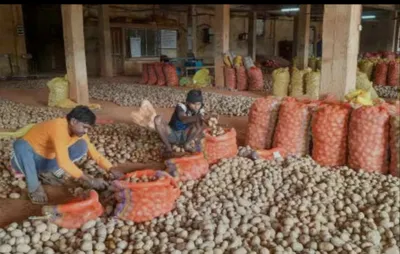
Potato farmers across West Bengal are facing severe financial stress as market prices have dropped sharply soon after harvesting began. Reports indicate that many farmers are being forced to sell potatoes at ₹3.50–₹4 per kg, while the estimated cost of production is around ₹7.50 per kg, resulting in significant losses.
The crisis has affected thousands of farmers across major potato-growing districts such as Hooghly, East Burdwan, Birbhum and West Midnapore, which together account for a large share of the state’s potato output. These districts alone are estimated to have around 15 lakh potato farmers, making the price crash a major agricultural concern.
Bumper Production Worsens Market Glut
One of the key reasons behind the price collapse is record production this year. According to industry sources, West Bengal is expected to produce around 130 lakh tonnes of potatoes, nearly 20 lakh tonnes more than last year’s output of 110 lakh tonnes.
Historically, whenever production in the state crosses 100 lakh tonnes, farmers often face price pressure during the harvest season due to supply gluts. Traders have also been cautious in buying large quantities because many suffered heavy losses in previous seasons. Last year, potatoes stored in cold storage were reportedly sold at as low as ₹2 per kg towards the end of the season.
Government Procurement Yet to Gain Momentum
To prevent distress sales, the state government had earlier announced a plan to procure 12 lakh tonnes of potatoes at ₹9.50 per kg. However, the initiative has not yet stabilised the market.
The procurement system relies on cold storage operators taking bank loans and purchasing potatoes from farmers, but only about 20% of the state’s 485 private cold storages have secured loans and started procurement so far. Additionally, around 10 cooperative cold storages have begun purchases, which remains insufficient compared to the scale of production.
Restrictions on Interstate Trade Impact Demand
Another challenge is reduced demand from neighbouring states. In the past, surplus potatoes from West Bengal were exported to states such as Bihar, Odisha, Jharkhand and Assam. However, frequent restrictions on interstate sales in previous years reportedly discouraged traders and reduced dependence on Bengal’s potatoes.
As a result, traders remain cautious about large-scale procurement this season.
Political Sensitivity Ahead of Elections
The issue has also gained political significance ahead of the upcoming West Bengal Assembly elections, as potato farmers form a key voter base in several districts of south Bengal.
Potato farmers across West Bengal are facing severe financial stress as market prices have dropped sharply soon after harvesting began. Reports indicate that many farmers are being forced to sell potatoes at ₹3.50–₹4 per kg, while the estimated cost of production is around ₹7.50 per kg, resulting in significant losses.
The crisis has affected thousands of farmers across major potato-growing districts such as Hooghly, East Burdwan, Birbhum and West Midnapore, which together account for a large share of the state’s potato output. These districts alone are estimated to have around 15 lakh potato farmers, making the price crash a major agricultural concern.
Bumper Production Worsens Market Glut
One of the key reasons behind the price collapse is record production this year. According to industry sources, West Bengal is expected to produce around 130 lakh tonnes of potatoes, nearly 20 lakh tonnes more than last year’s output of 110 lakh tonnes.
Historically, whenever production in the state crosses 100 lakh tonnes, farmers often face price pressure during the harvest season due to supply gluts. Traders have also been cautious in buying large quantities because many suffered heavy losses in previous seasons. Last year, potatoes stored in cold storage were reportedly sold at as low as ₹2 per kg towards the end of the season.
Government Procurement Yet to Gain Momentum
To prevent distress sales, the state government had earlier announced a plan to procure 12 lakh tonnes of potatoes at ₹9.50 per kg. However, the initiative has not yet stabilised the market.
The procurement system relies on cold storage operators taking bank loans and purchasing potatoes from farmers, but only about 20% of the state’s 485 private cold storages have secured loans and started procurement so far. Additionally, around 10 cooperative cold storages have begun purchases, which remains insufficient compared to the scale of production.
Restrictions on Interstate Trade Impact Demand
Another challenge is reduced demand from neighbouring states. In the past, surplus potatoes from West Bengal were exported to states such as Bihar, Odisha, Jharkhand and Assam. However, frequent restrictions on interstate sales in previous years reportedly discouraged traders and reduced dependence on Bengal’s potatoes.
As a result, traders remain cautious about large-scale procurement this season.
Political Sensitivity Ahead of Elections
The issue has also gained political significance ahead of the upcoming West Bengal Assembly elections, as potato farmers form a key voter base in several districts of south Bengal.
#PotatoPrices#WestBengalFarmers#FarmGatePrices#PotatoSupplyChain#PotatoBazaar#PotatoMarket#BumperCrop