Agriculture
26 February 2026
162 views
Source:Team Potatobazaar, The Indian Express
Punjab Seed Potato Crisis Deepens as Prices Crash Again
Punjab Seed Potato Crisis Deepens as Prices Crash Again
Doaba, Punjab - February 2026: In one of India’s most important seed potato belts, farmers are once again confronting a sharp price crash - this time despite being a major supplier of virus-free seed to potato growers nationwide. The Doaba region (comprising Jalandhar, Kapurthala, Hoshiarpur and SBS Nagar), which supplies around 60–65% of the country’s seed potato requirement, is facing what growers describe as a “golden seed glut” after a period of relative stability.
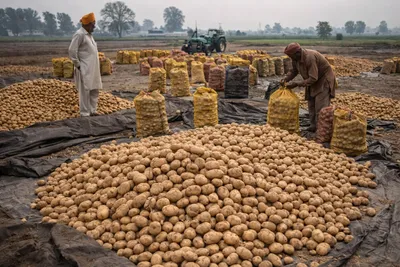
On the ground, freshly harvested tubers lie in heaps across fields - a stark contrast to the losses farmers are incurring. “Input costs are about ₹9–10 per kg, but markets are offering just ₹3–6 per kg - we can’t even recover our expenses, let alone return a profit,” said a local grower. This collapse comes after several years of balanced demand and supply cycles but has sparked widespread concern about the seed market’s volatility.
The paradox lies in Doaba’s dominant position in seed production. Punjab produces close to 33 lakh tonnes of potatoes annually, of which nearly 20 lakh tonnes qualify as seed. If farmers replaced seed every three years - the standard agricultural practice - this supply should align with national demand. However, the unregulated rise in seed cultivation in other states, including Haryana, Uttar Pradesh and Rajasthan, has diluted demand for Doaba’s certified seed.
Traders and local growers explain that in years of surplus, table potatoes are being sold as lower-priced seed, making farmers hesitate to buy certified seed from Doaba. Many growers outside Punjab also delay seed replacement, opting instead to reuse older or cheaper farm-saved materials. The result is an imbalance between theoretically stable demand and real market behaviour, leading to glut conditions - even in a region with high seed quality and virus-free reputation.
Farmers argue that corrective measures could include better market regulation, clearer differentiation between certified seed and table potatoes, and stricter adherence to recommended seed replacement cycles nationwide. Without such interventions, Doaba’s growers may continue to cycle between prosperity and crisis every few years - not due to lack of fundamental demand, but because of structural market distortions.
QUICK FACTS
- Location: Doaba region, Punjab, India
- Stakeholders affected: Seed potato farmers, traders, buyers from other states
- Immediate impact: Farmers forced to sell quality seed at low prices; increased financial stress
On the ground, freshly harvested tubers lie in heaps across fields - a stark contrast to the losses farmers are incurring. “Input costs are about ₹9–10 per kg, but markets are offering just ₹3–6 per kg - we can’t even recover our expenses, let alone return a profit,” said a local grower. This collapse comes after several years of balanced demand and supply cycles but has sparked widespread concern about the seed market’s volatility.
The paradox lies in Doaba’s dominant position in seed production. Punjab produces close to 33 lakh tonnes of potatoes annually, of which nearly 20 lakh tonnes qualify as seed. If farmers replaced seed every three years - the standard agricultural practice - this supply should align with national demand. However, the unregulated rise in seed cultivation in other states, including Haryana, Uttar Pradesh and Rajasthan, has diluted demand for Doaba’s certified seed.
Traders and local growers explain that in years of surplus, table potatoes are being sold as lower-priced seed, making farmers hesitate to buy certified seed from Doaba. Many growers outside Punjab also delay seed replacement, opting instead to reuse older or cheaper farm-saved materials. The result is an imbalance between theoretically stable demand and real market behaviour, leading to glut conditions - even in a region with high seed quality and virus-free reputation.
Farmers argue that corrective measures could include better market regulation, clearer differentiation between certified seed and table potatoes, and stricter adherence to recommended seed replacement cycles nationwide. Without such interventions, Doaba’s growers may continue to cycle between prosperity and crisis every few years - not due to lack of fundamental demand, but because of structural market distortions.
QUICK FACTS
- Location: Doaba region, Punjab, India
- Stakeholders affected: Seed potato farmers, traders, buyers from other states
- Immediate impact: Farmers forced to sell quality seed at low prices; increased financial stress
#SeedPotato#PriceCrash#PotatoMarket