Market
2 February 2026
63 views
Source:Team Potatobazaar, TOI
Union Budget Unveils AI Tool & Boosts Agri Funding.Key Takeaways for India’s Potato Sector
Union Budget Unveils AI Tool & Boosts Agri Funding.Key Takeaways for India’s Potato Sector
Budget 2026: Key Takeaways for India’s Potato Sector
The Union Budget 2026–27 signals a renewed push towards technology-driven agriculture, aiming to improve farm-level decision-making through digital tools and data-backed advisories. While the budget highlights innovation and diversification, its implications for staple crops like potato are mixed—offering progress on advisory support but limited relief on pricing and market stability.
Bharat Vistaar: AI Advisory for Smarter Farming
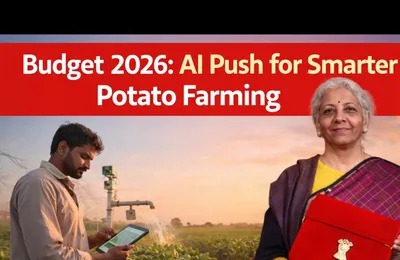
A major announcement relevant to potato farmers is the launch of Bharat Vistaar, a multilingual, AI-based agricultural advisory system. The platform is designed to deliver region-specific guidance in local languages, covering soil health, weather patterns, crop practices, and pest management. For potato cultivation—where sowing time, temperature sensitivity, disease control, and harvest timing directly influence yield and quality—such timely advisories can help reduce avoidable losses and improve outcomes at the field level.
Better Crop Planning and Risk Management
Bharat Vistaar is expected to combine national farm data with research-backed practices, enabling more informed planning around key crop stages such as planting, bulking, and harvesting. Weather-linked alerts may help farmers better manage risks from frost, unseasonal rain, or heat stress—common challenges in major potato-growing belts like Punjab, Uttar Pradesh, Gujarat, and West Bengal.
Agriculture Allocation but Limited Potato Focus
The budget has allocated ₹1.63 lakh crore to agriculture, with an emphasis on high-value and allied crops to boost rural incomes and employment. However, potatoes—despite being India’s largest vegetable crop by volume and a critical input for the processing industry—have not received any crop-specific policy support.
Unaddressed Issues: Prices, Mandis, and Storage
Key challenges such as price volatility during harvest, mandi infrastructure gaps, and cold storage economics remain unaddressed. These issues continue to affect farmer incomes, especially during surplus seasons when market prices weaken sharply.
Mixed Reactions from Agrarian States
Farmer representatives from key agrarian states have welcomed the focus on digital tools but raised concerns that technology alone cannot solve income instability without stronger market interventions and policy support.
Overall Takeaway for the Potato Community
In summary, Budget 2026–27 strengthens advisory and risk-management support for potato farming through digital innovation. However, the long-standing challenges of price assurance and predictable returns will require further policy action beyond technology-led initiatives.
The Union Budget 2026–27 signals a renewed push towards technology-driven agriculture, aiming to improve farm-level decision-making through digital tools and data-backed advisories. While the budget highlights innovation and diversification, its implications for staple crops like potato are mixed—offering progress on advisory support but limited relief on pricing and market stability.
Bharat Vistaar: AI Advisory for Smarter Farming
A major announcement relevant to potato farmers is the launch of Bharat Vistaar, a multilingual, AI-based agricultural advisory system. The platform is designed to deliver region-specific guidance in local languages, covering soil health, weather patterns, crop practices, and pest management. For potato cultivation—where sowing time, temperature sensitivity, disease control, and harvest timing directly influence yield and quality—such timely advisories can help reduce avoidable losses and improve outcomes at the field level.
Better Crop Planning and Risk Management
Bharat Vistaar is expected to combine national farm data with research-backed practices, enabling more informed planning around key crop stages such as planting, bulking, and harvesting. Weather-linked alerts may help farmers better manage risks from frost, unseasonal rain, or heat stress—common challenges in major potato-growing belts like Punjab, Uttar Pradesh, Gujarat, and West Bengal.
Agriculture Allocation but Limited Potato Focus
The budget has allocated ₹1.63 lakh crore to agriculture, with an emphasis on high-value and allied crops to boost rural incomes and employment. However, potatoes—despite being India’s largest vegetable crop by volume and a critical input for the processing industry—have not received any crop-specific policy support.
Unaddressed Issues: Prices, Mandis, and Storage
Key challenges such as price volatility during harvest, mandi infrastructure gaps, and cold storage economics remain unaddressed. These issues continue to affect farmer incomes, especially during surplus seasons when market prices weaken sharply.
Mixed Reactions from Agrarian States
Farmer representatives from key agrarian states have welcomed the focus on digital tools but raised concerns that technology alone cannot solve income instability without stronger market interventions and policy support.
Overall Takeaway for the Potato Community
In summary, Budget 2026–27 strengthens advisory and risk-management support for potato farming through digital innovation. However, the long-standing challenges of price assurance and predictable returns will require further policy action beyond technology-led initiatives.
#UnionBudget2026 #BharatVistaa#AgriFunding#Potato Sector#AI in Agriculture