Market
10 January 2026
74 views
Source:Team Potato Bazaar
The Global Potato Flakes Market: A Decade of Growth
The Global Potato Flakes Market: A Decade of Growth
The Global Potato Flakes Market
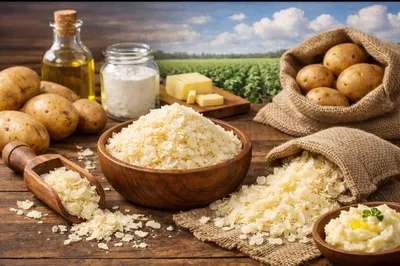
As of 2026, the global potato flakes market has evolved into a high-tech pillar of the international food supply chain. Driven by shifting consumer lifestyles and industrial innovation, the sector is currently valued at approximately US$ 2.3 billion (~₹20,760 crore). Industry forecasts project this figure to reach US$ 3.5 billion (~₹31,600 crore) by 2033, expanding at a steady compound annual growth rate (CAGR) of 6.1%.
Core Drivers: The Convenience Revolution
1. The primary engine behind this market growth is the soaring demand for convenience and ready-to-eat (RTE) meals. In an increasingly urbanized world defined by "time-poverty," consumers are gravitating toward ingredients that minimize preparation time. Potato flakes serve as a versatile foundation for instant mashed potatoes and thickeners, offering a shelf-stable solution that reduces reliance on fresh tubers.
2. The Foodservice and HoReCa (Hotels, Restaurants, and Cafes) sectors are also major contributors. By utilizing flakes, commercial kitchens ensure consistency in texture while slashing labor costs associated with peeling and boiling fresh potatoes.
Industrial Versatility and Application
Potato flakes have evolved beyond a simple side dish into a critical component of the snack food industry. They are indispensable for producing extruded snacks and fabricated potato chips. Their binding properties and moisture retention also make them a staple in:
1. Bakery Products: Enhancing the shelf life of breads and gluten-free items.
2. Soups and Sauces: Acting as a clean-label thickening agent.
3. Specialty Flakes: The rise of low-sodium and organic varieties caters to a health-conscious demographic willing to pay a premium.
Regional Insights: Asia-Pacific Takes the Lead
While North America has traditionally dominated the market due to its established processing infrastructure, the Asia-Pacific region is now the fastest-growing frontier.
India, in particular, is witnessing a massive surge in capacity driven by heavy hitters. Recent investments like HyFun Foods’ ₹850 crore (~US$ 94 million) expansion in Gujarat highlight the domestic push to meet both local and global demand.
Further fueling this growth is the emergence of strategic partnerships such as 3 Brother a joint venture between the snack giant Haldiram and SK Group. This venture has established a state-of-the-art potato flakes plant in Noida, featuring advanced Kiremko technology with a high production capacity of up to 2,400 kg/hr. This facility is designed to secure backward integration for Haldiram’s massive snack portfolio while aggressively targeting export markets. Driven by such large-scale projects, India's own potato flake market is expected to reach an estimated US$ 254 million (~₹2,300 crore) by 2033.
Challenges and Sustainability
Despite the positive outlook, the market faces headwinds. Climate change affects raw potato yields, causing price volatility. Furthermore, as the market scales toward its US$ 3.5 billion (~₹31,600 crore) goal, manufacturers are under pressure to adopt sustainable dehydration technologies and eco-friendly packaging to meet modern ESG standards.
The Competitive Landscape
The market is led by global giants such as McCain Foods, Lamb Weston, and Idahoan Foods. These players are increasingly focusing on R&D to develop "functional flakes" with added fiber or protein to differentiate themselves in a crowded marketplace.
Note: Conversions are based on an approximate early-2026 exchange rate of US$ 1 = ₹90.27.
As of 2026, the global potato flakes market has evolved into a high-tech pillar of the international food supply chain. Driven by shifting consumer lifestyles and industrial innovation, the sector is currently valued at approximately US$ 2.3 billion (~₹20,760 crore). Industry forecasts project this figure to reach US$ 3.5 billion (~₹31,600 crore) by 2033, expanding at a steady compound annual growth rate (CAGR) of 6.1%.
Core Drivers: The Convenience Revolution
1. The primary engine behind this market growth is the soaring demand for convenience and ready-to-eat (RTE) meals. In an increasingly urbanized world defined by "time-poverty," consumers are gravitating toward ingredients that minimize preparation time. Potato flakes serve as a versatile foundation for instant mashed potatoes and thickeners, offering a shelf-stable solution that reduces reliance on fresh tubers.
2. The Foodservice and HoReCa (Hotels, Restaurants, and Cafes) sectors are also major contributors. By utilizing flakes, commercial kitchens ensure consistency in texture while slashing labor costs associated with peeling and boiling fresh potatoes.
Industrial Versatility and Application
Potato flakes have evolved beyond a simple side dish into a critical component of the snack food industry. They are indispensable for producing extruded snacks and fabricated potato chips. Their binding properties and moisture retention also make them a staple in:
1. Bakery Products: Enhancing the shelf life of breads and gluten-free items.
2. Soups and Sauces: Acting as a clean-label thickening agent.
3. Specialty Flakes: The rise of low-sodium and organic varieties caters to a health-conscious demographic willing to pay a premium.
Regional Insights: Asia-Pacific Takes the Lead
While North America has traditionally dominated the market due to its established processing infrastructure, the Asia-Pacific region is now the fastest-growing frontier.
India, in particular, is witnessing a massive surge in capacity driven by heavy hitters. Recent investments like HyFun Foods’ ₹850 crore (~US$ 94 million) expansion in Gujarat highlight the domestic push to meet both local and global demand.
Further fueling this growth is the emergence of strategic partnerships such as 3 Brother a joint venture between the snack giant Haldiram and SK Group. This venture has established a state-of-the-art potato flakes plant in Noida, featuring advanced Kiremko technology with a high production capacity of up to 2,400 kg/hr. This facility is designed to secure backward integration for Haldiram’s massive snack portfolio while aggressively targeting export markets. Driven by such large-scale projects, India's own potato flake market is expected to reach an estimated US$ 254 million (~₹2,300 crore) by 2033.
Challenges and Sustainability
Despite the positive outlook, the market faces headwinds. Climate change affects raw potato yields, causing price volatility. Furthermore, as the market scales toward its US$ 3.5 billion (~₹31,600 crore) goal, manufacturers are under pressure to adopt sustainable dehydration technologies and eco-friendly packaging to meet modern ESG standards.
The Competitive Landscape
The market is led by global giants such as McCain Foods, Lamb Weston, and Idahoan Foods. These players are increasingly focusing on R&D to develop "functional flakes" with added fiber or protein to differentiate themselves in a crowded marketplace.
Note: Conversions are based on an approximate early-2026 exchange rate of US$ 1 = ₹90.27.
#PotatoFlakesMarket#FoodProcessingInnovation#ReadyToEatFoods