Market
15 December 2025
10 views
Source:Team Potato Bazaar
India's Potato Sector: The Processing and Export Pivot
India's Potato Sector: The Processing and Export Pivot
India's Potato Sector: The Processing and Export Pivot
The Indian potato industry is navigating a volatile market by shifting focus from fresh consumption to high-value processing and aggressive export growth, signaling a maturing agricultural economy. This strategic pivot is driven by both price instability and massive industrial partnerships.
Price Volatility and Market Reserves
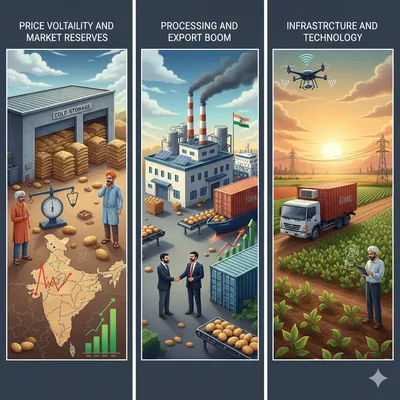
Recent market trends show significant regional disparities and price volatility. While the major producing states in the North and Central regions often face depressed prices (sometimes below the cost of production) due to bumper harvests and substantial cold storage carry-over stocks, Southern and remote markets command a premium. This gap highlights the persistent challenge of logistical inefficiencies and inadequate cold storage infrastructure at the farm gate. Effectively managing the existing large market reserves remains crucial to prevent future price crashes for the rabi harvest.
The Processing and Export Boom
The key opportunity lies in value addition. The potato processing market, led by the frozen potato segment (like French fries), is forecasted to grow at a Compound Annual Growth Rate (CAGR) of over 7% until 2030. In response, major global and domestic players are formalizing strong supply chains. A strategic partnership between the International Potato Center (CIP) and leading Indian processors has been announced to accelerate the development of climate-resilient, processing-grade varieties. This collaboration directly addresses the need for specific, uniform potato types that meet global standards for companies operating under contract farming models.
Focus on Infrastructure and Technology
Industry experts, at the Global Potato Summit 2025, urged for an integrated approach focusing on traceability, modernization, and export promotion. Government schemes, such as the Pradhan Mantri Kisan SAMPADA Yojana (PMKSY), are actively providing subsidies for modern cold chain and value addition infrastructure.
The future of Indian potato farming hinges on farmers transitioning to contract farming for stable returns and adopting modern, processing-suitable varieties to capitalize on India’s growing role as a reliable global supplier of both processed products and fresh exports to new markets in Asia and Africa.
The Indian potato industry is navigating a volatile market by shifting focus from fresh consumption to high-value processing and aggressive export growth, signaling a maturing agricultural economy. This strategic pivot is driven by both price instability and massive industrial partnerships.
Price Volatility and Market Reserves
Recent market trends show significant regional disparities and price volatility. While the major producing states in the North and Central regions often face depressed prices (sometimes below the cost of production) due to bumper harvests and substantial cold storage carry-over stocks, Southern and remote markets command a premium. This gap highlights the persistent challenge of logistical inefficiencies and inadequate cold storage infrastructure at the farm gate. Effectively managing the existing large market reserves remains crucial to prevent future price crashes for the rabi harvest.
The Processing and Export Boom
The key opportunity lies in value addition. The potato processing market, led by the frozen potato segment (like French fries), is forecasted to grow at a Compound Annual Growth Rate (CAGR) of over 7% until 2030. In response, major global and domestic players are formalizing strong supply chains. A strategic partnership between the International Potato Center (CIP) and leading Indian processors has been announced to accelerate the development of climate-resilient, processing-grade varieties. This collaboration directly addresses the need for specific, uniform potato types that meet global standards for companies operating under contract farming models.
Focus on Infrastructure and Technology
Industry experts, at the Global Potato Summit 2025, urged for an integrated approach focusing on traceability, modernization, and export promotion. Government schemes, such as the Pradhan Mantri Kisan SAMPADA Yojana (PMKSY), are actively providing subsidies for modern cold chain and value addition infrastructure.
The future of Indian potato farming hinges on farmers transitioning to contract farming for stable returns and adopting modern, processing-suitable varieties to capitalize on India’s growing role as a reliable global supplier of both processed products and fresh exports to new markets in Asia and Africa.
Potato ProcessingPotato exports