Market
15 December 2025
8 views
Source:Team Potato Bazaar
Global Potato Prices: Oversupply Clashes with Local Market Volatility
Global Potato Prices: Oversupply Clashes with Local Market Volatility
Global Potato Prices: Oversupply Clashes with Local Market Volatility
The current global potato market is defined by a sharp dichotomy: severe oversupply and low prices in key European and regional markets contrasting with localized volatility and supply chain pressures in Asia. Market analysts are calling for a "price correction in new contracts" to restore balance.
European Glut Drives Down Benchmark Prices
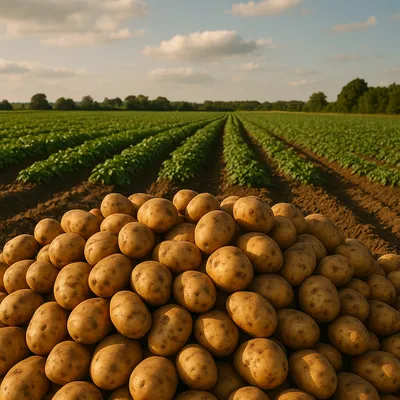
The benchmark potato price, as tracked by major commodities exchanges, has seen a dramatic correction, falling sharply year-on-year. This downward pressure is primarily due to record harvests in major European producing nations. This glut has intensified competition in the global export of processed products, forcing farmers in these regions to struggle with low farm-gate prices that often dip below their cost of production. This oversupply ripple effect is making it harder for producers worldwide to recover their increased cultivation costs (e.g., resilient cultivars, storage).
Indian Market Volatility and Regional Highs
In India, price news is highly fragmented. While national-level analysis shows a long-term trend of moderating prices (e.g., a 29% year-on-year drop in potato prices earlier this quarter) due to the release of abundant rabi season cold-storage stocks, extreme regional volatility persists.
States with high logistical dependence, particularly those in the South (e.g., Tamil Nadu) and remote North-East, continue to report high wholesale and retail rates. This is exacerbated by supply chain bottlenecks, quality concerns in existing stocks, and sporadic, localized demand surges. The underlying structural issue remains the difficulty of transporting and distributing vast cold-storage reserves efficiently to consumption centers without driving up costs.
The Export and Processing Pivot
Despite the price chaos, the sector's long-term value remains stable, driven by the expanding processed food market. India's potato market, now the second largest in the world, is projected to grow exponentially through 2030, led by demand for frozen products. This pivot underscores the need for farmers to move towards stable contract farming for processors, securing fixed prices and offsetting the severe risks associated with the fluctuating open fresh market.
The global focus is shifting to Asia-Pacific as a new powerhouse for frozen fry and chip production.
The current global potato market is defined by a sharp dichotomy: severe oversupply and low prices in key European and regional markets contrasting with localized volatility and supply chain pressures in Asia. Market analysts are calling for a "price correction in new contracts" to restore balance.
European Glut Drives Down Benchmark Prices
The benchmark potato price, as tracked by major commodities exchanges, has seen a dramatic correction, falling sharply year-on-year. This downward pressure is primarily due to record harvests in major European producing nations. This glut has intensified competition in the global export of processed products, forcing farmers in these regions to struggle with low farm-gate prices that often dip below their cost of production. This oversupply ripple effect is making it harder for producers worldwide to recover their increased cultivation costs (e.g., resilient cultivars, storage).
Indian Market Volatility and Regional Highs
In India, price news is highly fragmented. While national-level analysis shows a long-term trend of moderating prices (e.g., a 29% year-on-year drop in potato prices earlier this quarter) due to the release of abundant rabi season cold-storage stocks, extreme regional volatility persists.
States with high logistical dependence, particularly those in the South (e.g., Tamil Nadu) and remote North-East, continue to report high wholesale and retail rates. This is exacerbated by supply chain bottlenecks, quality concerns in existing stocks, and sporadic, localized demand surges. The underlying structural issue remains the difficulty of transporting and distributing vast cold-storage reserves efficiently to consumption centers without driving up costs.
The Export and Processing Pivot
Despite the price chaos, the sector's long-term value remains stable, driven by the expanding processed food market. India's potato market, now the second largest in the world, is projected to grow exponentially through 2030, led by demand for frozen products. This pivot underscores the need for farmers to move towards stable contract farming for processors, securing fixed prices and offsetting the severe risks associated with the fluctuating open fresh market.
The global focus is shifting to Asia-Pacific as a new powerhouse for frozen fry and chip production.
Potato market Prices