North India Potato Crash: ₹1000 Drop Imminent
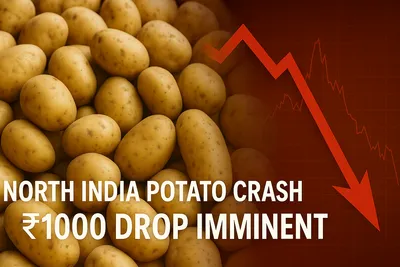
North India's potato markets experienced severe price collapse in November 2025. Wholesale prices crashed ₹600 to ₹1,000 per quintal compared to last year. Dadri APMC recorded the steepest decline at ₹1,021.88 per quintal. Full cold storages, excess supply, and weak demand created perfect conditions for this bearish trend. Farmers face significant income losses as December arrivals threaten further 10-15% price drops. According to KhetiVyapar (November 2025), this represents one of the most severe market corrections in recent years.
Key Numbers
Changes This Week
North India potato market shifted dramatically from November 1-30, 2025. Dadri APMC prices fell from ₹2,189.53 per quintal (2024) to ₹1,167.65 (2025), marking 46% year-over-year decline. Meerut APMC desi potatoes dropped ₹925.16 per quintal, while Prayagraj's Chandramukhi variety fell ₹863.22 per quintal. Lucknow APMC saw both potato categories decline ₹904.39 per quintal. Kanpur (Grain) APMC prices dropped ₹694.11 per quintal. Sirsa APMC recorded the smallest decline at ₹637.33 per quintal. Market traders predict December will bring another 10-15% price correction as local crop arrivals accelerate seasonal pressure.
Supply Analysis
North India's potato storage facilities reached full capacity by November 2025, eliminating demand for stored potatoes from earlier seasons. According to KhetiVyapar data, excess inventory combined with favorable weather conditions maintained consistent supply pressure throughout the month. Cold storage operators reported inability to absorb additional stock, forcing farmers to liquidate holdings at depressed prices. Desi and Chandramukhi varieties dominated market supplies, with arrivals from Punjab, Haryana, and Uttar Pradesh flooding mandis. Production levels exceeded demand expectations, creating fundamental oversupply. Traders noted that competition intensifies when fresh local potatoes enter markets in December, typically suppressing prices of transported stock by 10-15%. Current storage situation forces farmers to accept lower rates rather than maintain inventory. Supply chain dynamics show no meaningful constraint until January 2026 when cold storage capacity begins releasing controlled supplies.
Demand Signals
Market demand weakened significantly across North India in November 2025. Consumer purchasing power remained subdued during post-festive period. Restaurant and institutional demand showed no recovery. Processor buying remained minimal as chip manufacturers and frozen food producers maintained adequate stocks. Retail consumption stayed flat despite lower retail prices at ₹30-37 per kg according to CRISIL Ratings. Traders reported buyers adopting wait-and-watch approach, anticipating further price declines. No export opportunities emerged to absorb domestic glut. Bulk buyers postponed purchases pending December local crop arrivals. Demand weakness persisted despite prices falling to 46% below previous year levels. Potato inclusion in CRISIL's Roti Rice Rate (RRR) basket showed only 50% retail price increase versus 46% wholesale decline, indicating retail transmission lag. Consumer preference shifted toward other vegetables as potato prices declined slower in retail channels. Hospitality sector demand remained depressed post-festive season.
Regional Snapshot
lowest impact: Sirsa APMC, Haryana, ₹637.33 per quintal decline, full storage facilities absorbing inventory | highest impact: Dadri APMC, Uttar Pradesh, ₹1,021.88 per quintal decline, maximum price pressure from supply glut | stable: Lucknow APMC, Uttar Pradesh, ₹904.39 per quintal uniform decline both varieties, consistent market weakness across categories
Policy Risks
Government warehousing remained saturated, limiting policy intervention options. Ministry of Agriculture procurement schemes showed minimal activation in November 2025. APMC regulations did not restrict arrivals despite price collapse. Export restrictions continued limiting market relief options. Cold chain subsidies under government programs could not absorb excess produce at current capacity levels. No special procurement announcement emerged to support farmer incomes. Agricultural Ministry monitoring remained passive rather than interventionist. State governments in Uttar Pradesh, Punjab, and Haryana issued no emergency relief measures despite documented losses. Subsidy application processes for storage facilities typically require 30-45 days processing, making December intervention unlikely. Late blight mentioned in CRISIL report occurred in isolated regions but did not restrict overall supply. Fertilizer and input costs from earlier planting remain fixed expenses, creating margin compression for farmers. Price support schemes not activated at November levels. Trade policy uncertainty regarding processed potato exports continues limiting demand pathways.
FAQs
Q: Why did North India potato prices crash by ₹1,000 per quintal in November 2025?
A: According to KhetiVyapar (November 2025), full cold storage facilities, excess supply, and weak market demand combined creating severe oversupply. Higher production met lower consumption, forcing prices down ₹600-₹1,000 per quintal year-over-year across major APMCs.
Q: Which APMC recorded the largest potato price decline in November?
A: Dadri APMC (Uttar Pradesh) recorded the steepest decline at ₹1,021.88 per quintal, falling from ₹2,189.53 (2024) to ₹1,167.65 (2025). Meerut APMC followed with ₹925.16 per quintal decline per KhetiVyapar data.
Q: How much further will potato prices fall in December 2025?
A: Market traders predict 10-15% additional price decline when local crop arrives mid-December, according to KhetiVyapar analysis. Prices could drop another ₹120-195 per quintal from current November levels if predictions materialize.
Q: Should farmers sell now or wait for price recovery in January?
A: KhetiVyapar recommends assessing storage capacity and financial urgency. Farmers with adequate storage targeting January 2026 recovery may wait, while those needing immediate liquidity should liquidate at current ₹1,200-1,300 rates despite losses versus 2024.
Q: What government support exists for farmers facing November 2025 losses?
A: Cold storage subsidies available through Ministry of Agriculture schemes require 30-45 day processing; crop insurance claims possible if documented; state governments may announce price support in December if losses mount further.