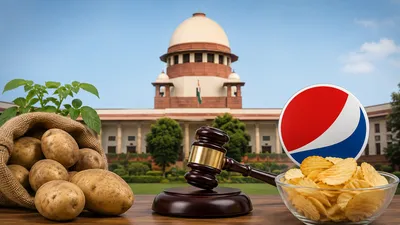
Supreme Court Upholds PepsiCo Potato Variety Registration; Reaffirms Farmers’ Rights
Judgment Date: 5 August 2026 | New Delhi | Potato Bazaar
The Supreme Court has upheld the restoration of PepsiCo India’s registration for its FL 2027 potato variety, popularly associated with FC-5 potatoes used for processing into chips. At the same time, the Court has made an equally important clarification: farmers continue to enjoy the special protections granted to them under India’s Protection of Plant Varieties and Farmers’ Rights (PPV&FR) Act, 2001.
The judgment therefore should not be seen simply as a victory for PepsiCo or a setback for farmers. It clarifies the coexistence of breeders’ rights and farmers’ rights under Indian law.
What was the Supreme Court deciding?
The immediate issue before the Court was whether PepsiCo’s registration of FL 2027 should remain valid, particularly in light of the company’s earlier infringement proceedings against Gujarat farmers.
Farmers’ rights activist Kavitha Kuruganti had argued that these cases were vexatious, intimidatory and contrary to public interest and therefore justified revocation of PepsiCo’s registration.
The Supreme Court disagreed with this proposition. It held that merely filing civil proceedings to protect a statutory right cannot, by itself, be treated as vexatious or intimidatory conduct. A registered rights-holder cannot be prevented from approaching the appropriate court when it believes its rights are being infringed.
Importantly, however, the Court did not rule that the farmers in those earlier cases had infringed PepsiCo’s rights.
So, can a farmer grow or save FL 2027 potatoes?
Yes — subject to the protection provided under Section 39(1)(iv) of the PPV&FR Act.
The law specifically allows a farmer to save, use, sow, resow, exchange, share or sell farm produce, including seed of a protected variety, broadly as farmers were entitled to do before the Act came into force.
There is an important exception: a farmer cannot sell branded seed of a protected variety.
Therefore, the existence of PepsiCo’s registration does not automatically mean that a farmer cultivating FL 2027 is infringing PepsiCo’s rights.
Then what rights does PepsiCo's registration provide?
The distinction lies here.
PepsiCo continues to hold statutory rights arising from the registration of FL 2027 and is entitled to approach a court if it believes those rights are being infringed.
But if proceedings are brought against an individual farmer, that farmer is entitled to invoke the protection of Section 39(1)(iv) and demonstrate that his or her activities fall within the farmers’ rights recognised by the Act.
The Supreme Court specifically said that such questions must be examined in the individual proceeding on its facts rather than assuming either that every action against a farmer is invalid or that every cultivation of a registered variety amounts to infringement.
Why is this distinction important?
The judgment effectively recognises two sets of rights operating together.
A breeder or company that has legally registered a plant variety retains enforceable rights over that variety. At the same time, India's PPV&FR law gives farmers unusually broad statutory freedoms over their farm produce and seed.
Thus, the ruling should not be interpreted as saying:
“Farmers cannot grow PepsiCo's FL 2027 potato.”
Nor does it say:
“Registration gives PepsiCo no enforceable rights against farmers.”
Instead, the Court's position is that PepsiCo can seek legal remedies where it believes its registered rights are being infringed, while a farmer facing such action can rely on the specific protections granted under Section 39.
PB Takeaway
For the potato industry, the key message from the 5 August 2026 Supreme Court judgment is the balance it maintains between breeder and farmer rights:
PepsiCo retains its registration and the right to protect FL 2027 against infringement. But registration does not take away the statutory rights of genuine farmers to save, sow, resow, exchange, share or sell their farm produce—including seed of a protected variety—subject to the restriction on selling branded seed.
Whether a particular activity constitutes protected farmer activity or infringement of a breeder’s rights will ultimately depend on the facts of the individual case.
That distinction is perhaps the most important practical takeaway from the judgment for India's potato farmers, seed businesses and processing industry.
Case: Kavitha Kuruganti v. PepsiCo India Holdings Pvt. Ltd.
Citation: 2026 INSC 811
Judgment: 5 August 2026
Bench: Justice J.B. Pardiwala and Justice K. Vinod Chandran