Market
7 May 2026
37 views
Source:Team Potatobazaar
Global Frozen Fries Market Faces Pressure as Processing Growth Outpaces Demand in Key Regions.
Global Frozen Fries Market Faces Pressure as Processing Growth Outpaces Demand in Key Regions.
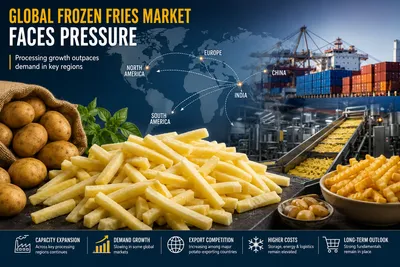
The global frozen French fry industry is entering a more challenging phase as rapid processing expansion across multiple countries begins to outpace demand growth in several major markets.
Over the last few years, potato processors in Europe, North America, China, India, and parts of South America aggressively expanded production capacity, encouraged by strong post-pandemic demand from quick-service restaurants, retail chains, and food delivery platforms.
Frozen potato consumption had risen sharply during that period due to:
• expansion of international QSR brands,
• increasing urban convenience food demand,
• growth in organised retail,
• and changing eating habits among younger consumers.
This encouraged processors worldwide to invest in:
• new French fry production lines,
• larger cold storage facilities,
• contract farming programs,
• and export-focused infrastructure.
However, industry analysts now believe the market is entering a temporary imbalance phase.
In Europe, one of the world’s largest frozen potato export hubs, processors are already dealing with excess raw potato availability and slower-than-expected export growth. Large potato crops across Belgium, the Netherlands, France, and Germany have increased pressure on industrial potato prices during recent months.
At the same time, freight volatility and weaker consumer spending in several economies have slowed demand recovery in some international markets.
North America is also witnessing increased competition in frozen potato exports, especially in price-sensitive regions where buyers are actively comparing supply offers from Europe and Asia.
Meanwhile, Asian processing industries continue to grow rapidly.
China has significantly expanded its frozen potato manufacturing capacity during the last few years, while India is steadily emerging as a competitive processing player supported by rising domestic consumption and improving cold-chain infrastructure.
India’s frozen fries segment, in particular, has seen strong investment momentum from both domestic companies and multinational food businesses.
States such as Gujarat, Uttar Pradesh, and Punjab are witnessing higher cultivation of processing-grade potato varieties suited for fries and snack manufacturing. The expansion of quick-service restaurant chains and organised food retail within India is also supporting long-term demand growth.
Despite the positive consumption outlook, industry experts believe processors globally may now face tighter margins because:
• raw material production has increased faster than demand growth in some regions,
• energy and storage costs remain elevated,
• export competition is intensifying,
• and global buyers are becoming more price sensitive.
Another major concern is utilisation pressure.
Many newly expanded processing plants require consistently high operating volumes to remain economically efficient. If global demand growth slows further, processors may struggle with underutilised capacities and increased pricing competition.
Cold storage operators are also under pressure in several countries due to rising electricity costs and longer inventory holding periods.
Still, most analysts believe the long-term fundamentals of the potato processing industry remain strong.
Frozen potato consumption continues to expand steadily across developing economies where urbanisation, modern retail, food delivery platforms, and changing dietary habits are driving higher demand for convenience foods.
India, Southeast Asia, the Middle East, and Africa are expected to remain important long-term growth markets for frozen potato products.
For now, however, the global potato processing industry appears to be entering a period where operational efficiency, export competitiveness, and demand management will become more important than simple production expansion.
The current situation is also serving as a reminder that even fast-growing agricultural processing industries can face cyclical pressure when supply growth temporarily moves ahead of real market demand.
Over the last few years, potato processors in Europe, North America, China, India, and parts of South America aggressively expanded production capacity, encouraged by strong post-pandemic demand from quick-service restaurants, retail chains, and food delivery platforms.
Frozen potato consumption had risen sharply during that period due to:
• expansion of international QSR brands,
• increasing urban convenience food demand,
• growth in organised retail,
• and changing eating habits among younger consumers.
This encouraged processors worldwide to invest in:
• new French fry production lines,
• larger cold storage facilities,
• contract farming programs,
• and export-focused infrastructure.
However, industry analysts now believe the market is entering a temporary imbalance phase.
In Europe, one of the world’s largest frozen potato export hubs, processors are already dealing with excess raw potato availability and slower-than-expected export growth. Large potato crops across Belgium, the Netherlands, France, and Germany have increased pressure on industrial potato prices during recent months.
At the same time, freight volatility and weaker consumer spending in several economies have slowed demand recovery in some international markets.
North America is also witnessing increased competition in frozen potato exports, especially in price-sensitive regions where buyers are actively comparing supply offers from Europe and Asia.
Meanwhile, Asian processing industries continue to grow rapidly.
China has significantly expanded its frozen potato manufacturing capacity during the last few years, while India is steadily emerging as a competitive processing player supported by rising domestic consumption and improving cold-chain infrastructure.
India’s frozen fries segment, in particular, has seen strong investment momentum from both domestic companies and multinational food businesses.
States such as Gujarat, Uttar Pradesh, and Punjab are witnessing higher cultivation of processing-grade potato varieties suited for fries and snack manufacturing. The expansion of quick-service restaurant chains and organised food retail within India is also supporting long-term demand growth.
Despite the positive consumption outlook, industry experts believe processors globally may now face tighter margins because:
• raw material production has increased faster than demand growth in some regions,
• energy and storage costs remain elevated,
• export competition is intensifying,
• and global buyers are becoming more price sensitive.
Another major concern is utilisation pressure.
Many newly expanded processing plants require consistently high operating volumes to remain economically efficient. If global demand growth slows further, processors may struggle with underutilised capacities and increased pricing competition.
Cold storage operators are also under pressure in several countries due to rising electricity costs and longer inventory holding periods.
Still, most analysts believe the long-term fundamentals of the potato processing industry remain strong.
Frozen potato consumption continues to expand steadily across developing economies where urbanisation, modern retail, food delivery platforms, and changing dietary habits are driving higher demand for convenience foods.
India, Southeast Asia, the Middle East, and Africa are expected to remain important long-term growth markets for frozen potato products.
For now, however, the global potato processing industry appears to be entering a period where operational efficiency, export competitiveness, and demand management will become more important than simple production expansion.
The current situation is also serving as a reminder that even fast-growing agricultural processing industries can face cyclical pressure when supply growth temporarily moves ahead of real market demand.
#FrozenFries#GlobalPotatoTrade#ProcessingPotatoes