Farming (Agronomy)
Post Harvesting Potato Care
6 December 2025
Post Harvesting Potato Care
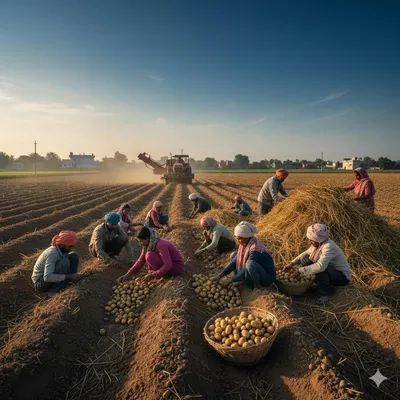
This stage is critical for minimizing losses, preparing for market, and ensuring long storage life.
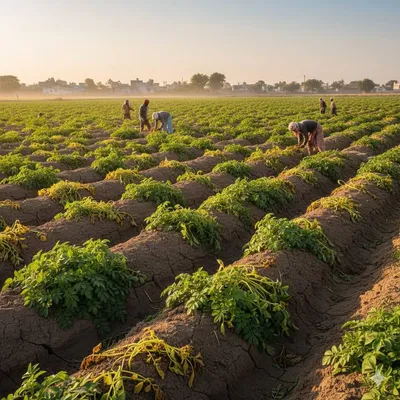
a) Harvest during Cool Conditions: Harvest the crop on a cool, dry day, preferably in the morning or late afternoon, to keep tuber pulp temperature low and minimize bruising.
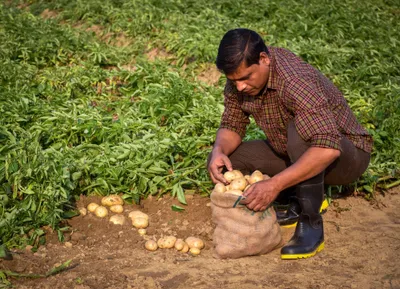
b) Minimize Mechanical Damage: Handle tubers gently during lifting and collection. Avoid bruising and skinning as injuries serve as entry points for storage diseases and reduce storage life significantly.
c) Field Curing/Drying (Temporary):After lifting, allow tubers to dry in the field only for a few hours in the shade (under haulms or canvas). Never expose tubers to direct sun for long periods, as this causes greening and reduces quality.
d) Sorting and Grading: Immediately sort the potatoes, separating the following:
Damaged/Cut/Diseased tubers (use immediately).
Greened tubers (discard for consumption).
Undersized/Oversized tubers.
Grade sound tubers based on size (small, medium, large) as per market requirements.
e) Curing (Wound Healing): For long-term storage, potatoes should undergo Curing. This involves storing them for 10-14 days at a warm temperature (approx 10-15 centigrade) and high humidity (approx 90-95%). This heals minor wounds and toughens the skin.
f) Storage Preparation: Store disease-free, fully cured tubers in a dark, cool, and well-ventilated area (or a certified cold storage). For indigenous storage (e.g., heap storage), cover the piles with thick Paddy/Wheat Straw to protect against the Potato Tuber Moth (PTM) and light.
This stage is critical for minimizing losses, preparing for market, and ensuring long storage life.
a) Harvest during Cool Conditions: Harvest the crop on a cool, dry day, preferably in the morning or late afternoon, to keep tuber pulp temperature low and minimize bruising.
b) Minimize Mechanical Damage: Handle tubers gently during lifting and collection. Avoid bruising and skinning as injuries serve as entry points for storage diseases and reduce storage life significantly.
c) Field Curing/Drying (Temporary):After lifting, allow tubers to dry in the field only for a few hours in the shade (under haulms or canvas). Never expose tubers to direct sun for long periods, as this causes greening and reduces quality.
d) Sorting and Grading: Immediately sort the potatoes, separating the following:
Damaged/Cut/Diseased tubers (use immediately).
Greened tubers (discard for consumption).
Undersized/Oversized tubers.
Grade sound tubers based on size (small, medium, large) as per market requirements.
e) Curing (Wound Healing): For long-term storage, potatoes should undergo Curing. This involves storing them for 10-14 days at a warm temperature (approx 10-15 centigrade) and high humidity (approx 90-95%). This heals minor wounds and toughens the skin.
f) Storage Preparation: Store disease-free, fully cured tubers in a dark, cool, and well-ventilated area (or a certified cold storage). For indigenous storage (e.g., heap storage), cover the piles with thick Paddy/Wheat Straw to protect against the Potato Tuber Moth (PTM) and light.
Tags
Potato harvesting